Why am I in Canada Today?
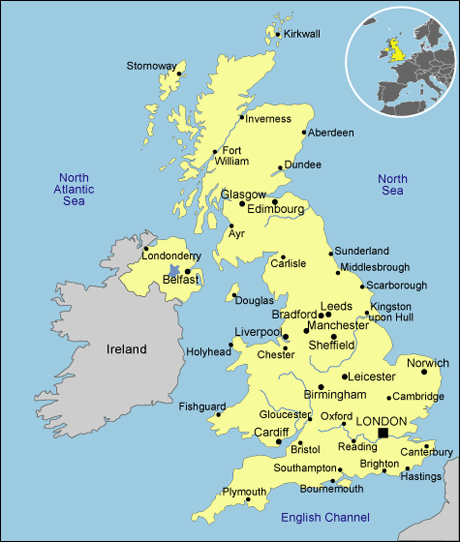
Before taking on this assignment I had little knowledge on where my ancestors came from and why I'm in Canada today. Upon doing some research online and calling my grandma, I found out information I would never have known about my past. I found out that my great great grandfather Fredrick William Kittle immigrated to Canada from Norfolk, Norwich England in 1906.
Norfolk, Norwich England Lavoy, Alberta
 →
→
The Story About My Past
In the late 1800s and early 1900s my ancestors lived in Norfolk, Norwich England. Life was getting tough for them in England, finding jobs was a challenge because work was low so the unemployment rates were high. So my great great grandfather Fredrick William Kittle and his wife Edith Kittle wanted to move to Canada or Australia to seek a new life. They flipped a coin to see which country they’ll be moving to and it ended up landing on Canada. Fredrick and Edith immigrated to Montreal, Canada in 1906 and ended up living in a tent quarantine for the winter to make sure they didn't carry over a sickness. After the winter they moved to Lavoy, Alberta to become a homesteader and own a piece of land for farming. They bought 160 acres of land then later bought 320 more acres, they maintained the land by using horses and then they bought a $2000 tractor to plow the land. They used the land for growing crops and raising cows pigs, chickens, and turkeys, there was lots of work, but it had to be done to survive because of the dirty thirties. Fredrick and Edith kids owned their own blacksmith shop and the shop became very successful. Fredrick Kittle went back to England to fight in World War 1, but ended up not fighting because he had a perforated ear drum. During that time his sons worked on the farm to feed the soldiers. Fredrick Kittle came back to Canada to work on the farm with Edith and his sons for the rest of his life.


 |
This is my great great grandfathers
Attestation Paper,this is how he
signed up to go to war.
|
What is Life Like in England Today?
Life in Norfolk, Norwich England today is a little bit different than life in Canada. In terms of education. Education system in the UK is divided into four main parts, primary education, secondary education, further education and higher education. Children in the UK have to legally attend primary and secondary education which runs from about 5 years old until the student is 16 years old, education is free for all children from 5 to 18 years old.
Primary education: begins in the UK at age 5 and continues until age 11
Secondary Education: From age 11 to 16, students will enter secondary education
Further Education: Once a student finishes secondary education they have the option to extend into further education
take their A-Levels, GNVQs, BTEC's or other such qualifications. UK students planning to go to college or university must complete further education.
Higher Education: College and University
 Working In England
The rules for working in England is similar to the rules in Canada, you can’t work more than 48 hours a week on average and if you are under the age of 18 you can’t work more than 8 hours a day or 40 hours a week. The minimum wage in England is now set at £9.15 an hour in London and £7.85 an hour in the rest of the UK.

 Politics
England is a member of the United Kingdom, the rest of which consist of Wales, Scotland and Northern Ireland. As such, it is under the basic political system. So, its political structure consists of a constitutional monarchy and a parliament. The ruler is currently Queen Elizabeth II. Born on 21 April 1926, she has been ruling since 6 February 1952. She is the daughter of George VI, who was the last Emperor of India.England last had a government in 1707. However, in that year, the Acts of Union joined England and Scotland to form the Kingdom of Great Britain. Since then, England has been ruled directly by the parliament.
Statistics About The UK
Unemployment, youth ages 15-24:
Total: 16.9%
Male: 18.9%
Female: 14.8%
School life expectancy (primary to tertiary education):
Total: 18 years
Male: 17 years
Female: 18 years
Life expectancy at birth:
Total population: 80.7 years
Male: 78.5 years
Female: 83 years
Religions:
Christian 59.5%, Muslim 4.4%, Hindu 1.3%,
other 2%, unspecified 7.2%, none 25.7%
other 2%, unspecified 7.2%, none 25.7%
Languages:
English
Population:
64,430,428
Area:
Total: 243,610 sq km
Land: 241,930 sq km
Water: 1,680 sq km
 Pros and Cons of Living In England
Pros: Cons:
- Universal health care - Cost of living is high
- Good food - Weather is bad
- Good selection of schools - Air Pollution
- Good public transit system - High price of gas
- Safe
Conclusion
In conclusion if I was still living in Norwich, Norfolk England today, my life wouldn’t be so different in terms of working. Although the education in England compared to the education in Canada is very different. If I was still in England I would have completed my high school education and will be working towards the next chapter in my life, college or university. Overall I am happy my ancestors moved to Canada in the early 1900s.
Works Cited
“Life in the UK.” English UK, www.englishuk.com/en/agents/english-in-the-uk/life-in-the-uk. Accessed 14 Jan. 2017.
“Maximum Weekly Working Hours.” Gov.UK, www.gov.uk/maximum-weekly-working-hours/overview. Accessed 14 Jan. 2017.
“1921 Census of Canada.” Ancestry, 2006, search.ancestry.ca/search/db.aspx?dbid=8991. Accessed 14 Jan. 2017.
“UK Education System.” International Student, www.internationalstudent.com/study_uk/education_system/. Accessed 14 Jan. 2017.
“What Is the Living Wage?” BBC News, BBC, 2 Nov. 2014, www.bbc.com/news/business-20204594. Accessed 14 Jan. 2017.
“The World Factbook.” Central Intelligence Agency, www.cia.gov/library/publications/resources/the-world-factbook/geos/uk.html. Accessed 14 Jan. 2017.

Overall, I really enjoyed your blog post about your family history, and I agree that in terms of working your life would be similar. This is because as you stated,"if you are under the age of 18 you can’t work more than 8 hours a day or 40 hours a week". I also know this is true for Canada's youth population. The question I have for you is what would you be working as if you continued life in England? Where would you be working and would you still need to work if your family had never come to Canada or would your financial situation be different in England. In addition, I thought the family history was very interesting when your grandparents, " used the land for growing crops and raising cows pigs, chickens, and turkeys, there was lots of work, but it had to be done to survive because of the dirty thirties". I know my grandparents faces similar struggles to provide for themselves. Finally, The fact that your relatives had, "flipped a coin" in order to decide the place they would settle, is important as if the coin had landed on the other side your life now would be drastically changed from how it is now.
ReplyDeleteThis comment has been removed by the author.
ReplyDeleteGreat blog Wes, I really enjoyed reading it. I have a question about further education and higher education. How long would you be in further education and higher education? What are some of the options available in terms of courses? What are the requirements for jobs? (i.e PHD, Masters Degree, etc). And after the age of 18, what would the cost look like for higher education? And finally would you need to work throughout further and higher education?
ReplyDelete